
 25
25
 25
25
Goal: First to 10 Victory Points wins.
Setup: Snake draft — each player places 2 settlements + 2 roads. 2nd placement gives starting resources.
Turn: Roll → Collect → Build/Trade/Dev Card → End Turn.
On 7: Players with >7 cards discard half. Active player moves Robber and steals.
Settlement = 1VP · City = 2VP · Longest Road = 2VP · Largest Army = 2VP
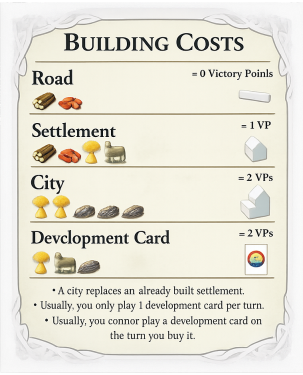
Road: Wood+Brick | Settlement: W+B+Sh+Wh | City: 3Ore+2Wheat
Dev Card: Ore+Wheat+Sheep. Can't play same turn. Max 1/turn.
Ports: Settle on port for 3:1 generic or 2:1 specific bank trade.
Hexland is a race to build the strongest network of roads, settlements and cities on a freshly discovered island. You earn Victory Points (VP) for what you build and for special achievements.
This game is built for 2–4 players per room. Empty seats can be filled by AI opponents.
The board is made of 19 hexagonal tiles, shuffled and laid out freshly every game. Five tile types each produce one resource; the desert produces nothing.






Each non-desert tile carries a number token (2–12). When that number is rolled, the tile produces resources for every settlement and city touching it. The desert starts as the home of the Robber (see §11).
Producing tiles pay out in resource cards. These five resources are the currency of Hexland — everything you build is paid for with them.

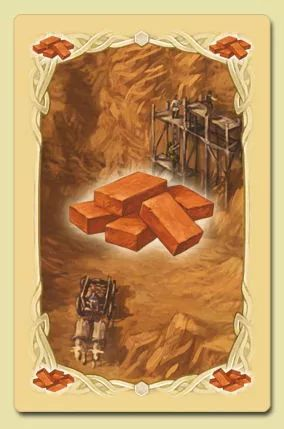



Your current hand is always shown in the resource panel. There is no hard limit on how many cards you may hold — but if you are holding more than 7 cards when a 7 is rolled, you must discard half of them (see §11).
Every player has a fixed, limited supply of building pieces in their colour. Running out means you cannot build that piece again until you free one up (only settlements can be freed — by upgrading them to cities).


Settlements and cities collect resources; roads connect your network and let you reach new building spots. A city counts as a settlement that was upgraded — upgrading returns the settlement piece to your supply.
Each turn begins by rolling two six-sided dice. Their sum (2–12) decides which tiles produce this turn.
Number tokens show their value plus a row of dots: more dots = more likely. The values 6 and 8 are the most common rolls, so they are printed in red — settling next to them pays off most often. The number 7 is never on a tile; rolling a 7 triggers the Robber instead (see §11).
A roll only produces for tiles that have a settlement or city on one of their six corners — a settlement collects 1 card, a city collects 2.
Turn order is randomised, then everyone places their starting pieces in a "snake draft" — forward through the players, then back again:
If your placement timer runs out, the game auto-places a valid settlement and road for you. You can move an auto-placed pair later, during setup, from the board prompt.
You may play one Development Card per turn, and you can play it before or after rolling — except a card bought this very turn, which must wait until a later turn.
Pay the cost, then place the piece. Build costs are fixed:
| Road connects your network |
 
|
1 Wood + 1 Brick |
| Settlement +1 VP |
 
|
1 Wood + 1 Brick + 1 Sheep + 1 Wheat |
| City +1 VP (upgrade) |

|
3 Ore + 2 Wheat |
| Dev. Card see §10 |
|
1 Ore + 1 Wheat + 1 Sheep |
With players: on your turn, propose any swap of resources. Each opponent may accept or decline; the trade only happens if someone accepts.
With the bank / ports: you can always trade up at a fixed rate. Building a settlement on a port improves your rate for trades made there:
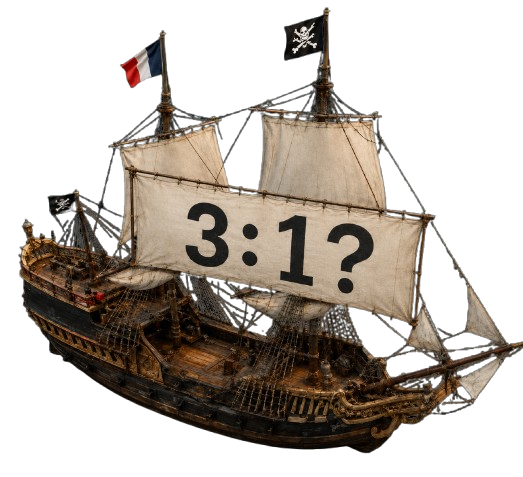 3 : 1
3 : 1

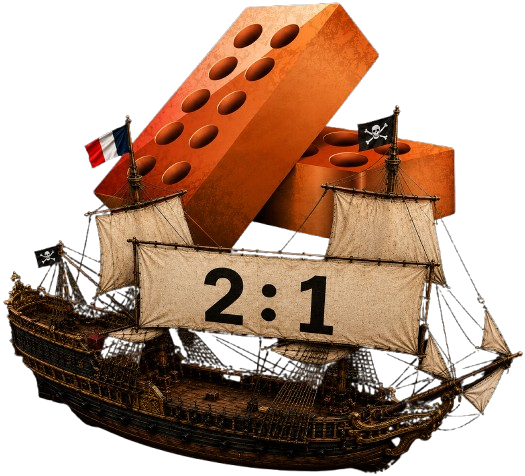


 2 : 1
2 : 1
Each give-resource trades at its own best available rate. You only get a port's rate once you have a settlement or city sitting on that port.
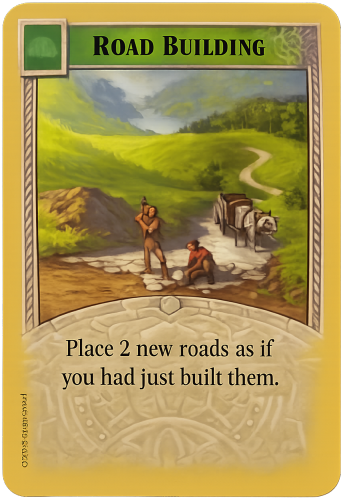
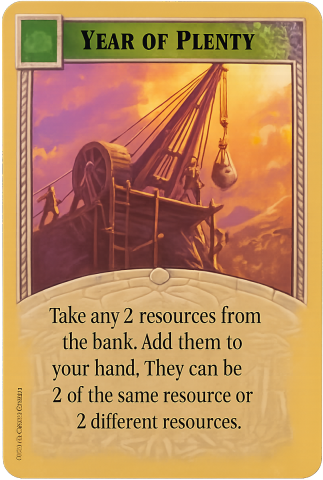
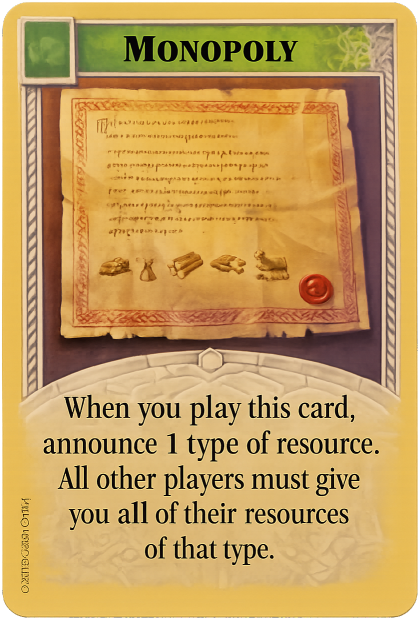
Buy a Development Card (1 Ore + 1 Wheat + 1 Sheep) and draw the top card of the shuffled 25-card deck. Cards stay hidden in your hand until you play them — one per turn, and never the turn you bought it.
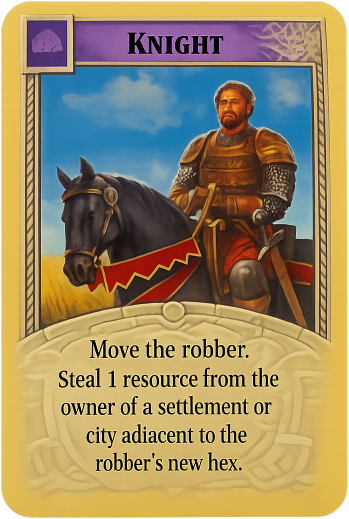

The Robber sits on a tile and blocks all production there — that tile pays out nothing while the Robber is on it.
When anyone rolls a 7 (or plays a Knight):
Rolling a 7 produces no resources for anyone. If the active player's timer runs out before moving the Robber, the turn passes and the Robber stays where it is.
Two bonus cards are worth 2 VP each and can change hands during the game.
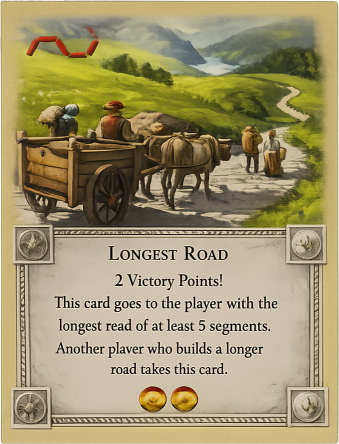
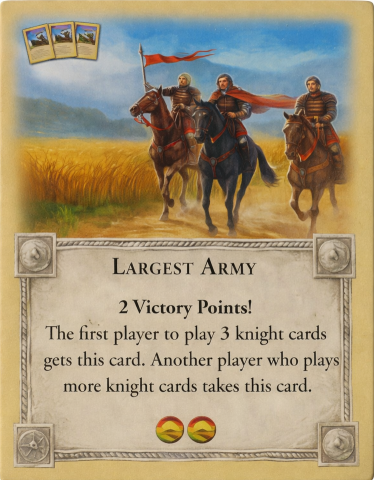
Add up every source of Victory Points. The instant a player reaches 10 VP on their own turn, they win.
| Each settlement | 1 VP |
| Each city | 2 VP |
| Longest Road | 2 VP |
| Largest Army | 2 VP |
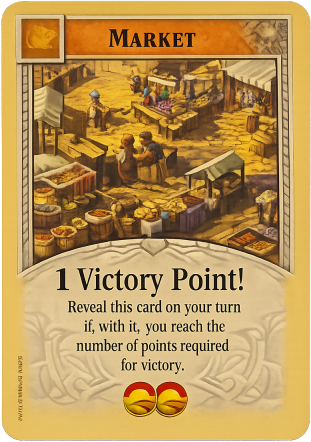
| Each Victory Point card | 1 VP |
Hidden Victory Point cards count toward the total — a player can win unexpectedly by revealing them, so watch opponents who are sitting on 8–9 visible points.